
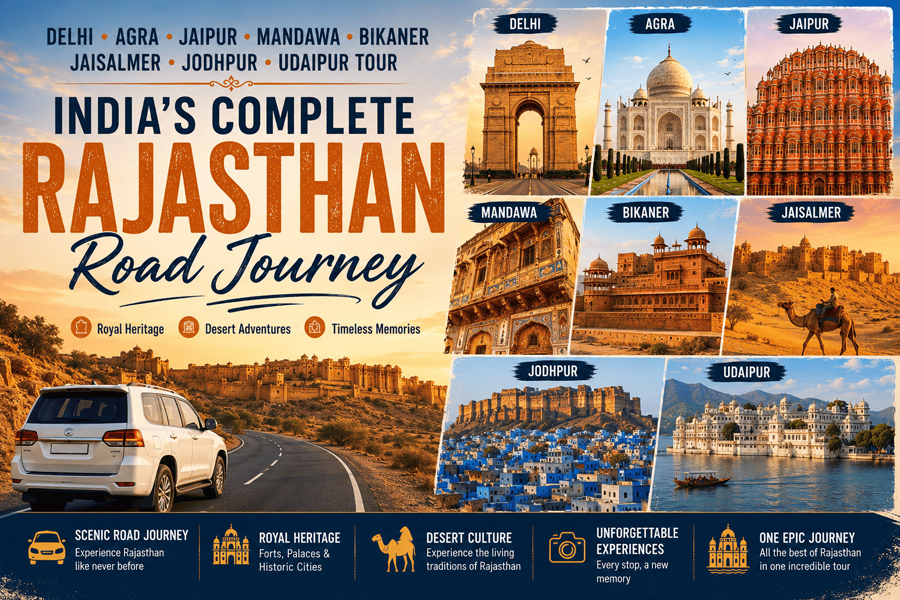
This is the longest common Rajasthan itinerary for a reason: it’s the only route that adds Shekhawati’s painted havelis and Bikaner’s desert fort city on top of everything the shorter Rajasthan routes already cover. Where a 9-day Udaipur-Jodhpur-Jaisalmer trip gives you lakes, blue-city forts, and true desert, this 12-day version adds two regions most visitors never reach at all — and in doing so, turns a great Rajasthan trip into the complete one.
If you’ve looked at the shorter routes and felt like something was still missing, Mandawa and Bikaner are usually it.
What Mandawa and Bikaner Add That Nothing Else on the Map Does
Mandawa sits in the Shekhawati region, often called an open-air art gallery — a cluster of small towns where 19th-century merchant families competed to build the most elaborately frescoed havelis, painted with everything from Hindu mythology to early depictions of trains and airplanes. Nowhere else on any Rajasthan route looks like this. It’s not a fort, not a palace, not a temple — it’s domestic architecture turned into public art, and it’s largely unrestored, which is part of what makes it feel real rather than curated.
Bikaner brings Junagarh Fort, unusual among Rajasthan’s major forts for being built on flat ground rather than a hilltop, with elaborately lacquered interiors and glass-inlay work that differs noticeably from Jaipur’s or Jodhpur’s fort styles. Bikaner is also a working desert city rather than a tourist-oriented one — the drive between Mandawa and Bikaner, and Bikaner and Jaisalmer, crosses genuine Thar Desert terrain, which is where this route starts to feel less like a monument tour and more like an actual overland journey.
The Full Route
Delhi → Agra → Jaipur covers the classic Golden Triangle opening, unchanged from the shorter routes — sunrise at the Taj Mahal, a Fatehpur Sikri stop, and a full day of Jaipur’s forts and palaces.
Jaipur → Mandawa, roughly 4 hours, is where this route breaks away from everything else on this list. An afternoon or evening walking Mandawa’s haveli-lined streets is enough to see the region’s distinctive frescoes.
Mandawa → Bikaner, another 4-5 hours further into the desert, brings you to Junagarh Fort and the city’s own distinct architectural style.
Bikaner → Jaisalmer crosses a genuine stretch of the Thar Desert, arriving at the “Golden City” and its living fort, Sonar Kila.
Jaisalmer gets a full sightseeing day — the fort itself, the carved havelis of local merchant families, Gadisar Lake, and a sunset camel safari in the Sam dunes.
Jaisalmer → Jodhpur returns you toward central Rajasthan, to Mehrangarh Fort and the Blue City’s old town.
Jodhpur → Udaipur, broken up by the Ranakpur Jain Temple’s 1,444 uniquely carved pillars, brings you to the trip’s final city.
Udaipur closes with its own full sightseeing day — Lake Pichola, City Palace, and the lake-city atmosphere that nothing else on this route resembles.
Udaipur → Delhi is done by flight, the same way Jaisalmer-based itineraries end by air rather than a long return drive — Udaipur simply sits at the other end of the loop on this longer version.
How Long and How Demanding Is It
At 12 days and 11 nights, this is a genuine commitment — roughly double the classic Golden Triangle, and three days longer than the 9-day Udaipur-Jodhpur-Jaisalmer route. The trade-off is real: you’re spending several days specifically in transit through desert terrain between Mandawa, Bikaner, and Jaisalmer, in exchange for reaching two regions most Rajasthan trips skip entirely.
A pre-built version of this route — like this Delhi-Agra-Jaipur-Mandawa-Bikaner-Jaisalmer-Jodhpur-Udaipur tour by car sequences all eight destinations with the desert-crossing legs, the Ranakpur stop, and the final flight already worked into the schedule. Aiza Tours runs this as one of its longest routes, with a single driver and vehicle for the full 12 days and local guides joining in each city — worth confirming directly if you’re comparing it against a self-planned version, since coordinating eight separate city-to-city legs yourself is a meaningfully bigger task than it is on the shorter routes.
Best Food to Eat Along the Route
Mandawa and the Shekhawati region lean toward simple, hearty Rajasthani thali food — the towns here are smaller and less geared toward tourist dining than Jaipur or Udaipur, so meals tend to be home-style rather than restaurant-polished.
Bikaner is famous well beyond Rajasthan for Bikaneri Bhujia, a spiced gram-flour snack that’s become one of India’s most widely exported namkeen products — trying it at its source is a genuinely different experience from the packaged version sold nationwide. Rasgulla here also has a distinct local variation worth trying alongside the standard Rajasthani thali.
Jaisalmer and Jodhpur repeat the desert-region staples covered on the shorter routes — Ker Sangri, Mirchi Bada, Makhaniya Lassi — while Udaipur closes the trip with its lighter, lake-city dining.
Best Shopping Places
Mandawa is less about markets and more about the haveli architecture itself, though small shops selling regional textiles and antiques are scattered through the old town.
Bikaner is known for Usta art — intricate gold-leaf and lacquer work applied to camel leather, a craft genuinely unique to this city — alongside the region’s spice markets.
Jaisalmer’s stone and mirror-work handicrafts, Jodhpur’s Clock Tower market, and Udaipur’s miniature paintings round out the route exactly as they do on the shorter itineraries.
Best Activities to Cover
Mandawa: A slow walking tour of the haveli district, ideally with a local guide who can point out which frescoes depict what — many are easy to miss without context, since they’re worked into ordinary building facades rather than displayed as standalone art.
Bikaner: Beyond Junagarh Fort, the National Research Centre on Camel just outside the city is a genuine curiosity stop — Bikaner has long been associated with camel breeding, and it’s one of the only places in India to see it up close.
Jaisalmer, Jodhpur, and Udaipur repeat their signature experiences from the shorter routes: the Sam dunes camel safari, Mehrangarh Fort’s Flying Fox zip-line, and a sunset boat ride on Lake Pichola.
How This Compares to Shorter Rajasthan Routes
| Golden Triangle | + Jodhpur & Pushkar | + Udaipur & Jaisalmer | This Route (+ Mandawa & Bikaner) | |
|---|---|---|---|---|
| Cities | 3 | 5 | 6 | 8 |
| Duration | 5–6 days | 7 days | 9 days | 12 days |
| Core themes | Imperial history | + desert culture, pilgrimage | + lakes, true desert | + Shekhawati art, desert fort cities |
| Return transport | Train-friendly | By car | By car, then flight from Jaisalmer | By car, then flight from Udaipur |
| Signature add | Taj Mahal sunrise | Camel safari, Brahma Temple | Lake Pichola, Sonar Kila | Mandawa frescoes, Junagarh Fort |
| Best for | First-time, tight schedule | Deeper Rajasthan culture | Most complete loop in 9 days | Travelers who want to see all of Rajasthan in one trip |
Best Time to Go
October to March matters even more here than on the shorter routes, since a meaningful stretch of this itinerary — Mandawa to Bikaner to Jaisalmer — runs directly through open desert with limited shade or infrastructure between stops. Outside the cooler months, the combination of long desert drives and full sightseeing days becomes genuinely taxing rather than just warm.
Common Questions
Is 12 days too long for a first trip to India? It’s a substantial trip, and most first-time visitors are better served by the classic Golden Triangle or the 9-day Udaipur-Jaisalmer route. This 12-day version suits travelers who’ve either done a shorter Rajasthan trip before or specifically want the most complete version in one go.
What’s the actual difference between Mandawa and the rest of Rajasthan’s fort towns? Mandawa has no major fort of its own — its distinction is domestic architecture, specifically the painted havelis built by wealthy merchant families, which don’t appear anywhere else on the standard Rajasthan circuit.
Is Bikaner worth the extra driving day, or is it skippable? If your priority is efficiency, Bikaner is the most skippable stop on this route, since Junagarh Fort, while distinctive, covers similar ground thematically to Jodhpur’s and Jaisalmer’s forts. It earns its place mainly as a bridge between Mandawa and Jaisalmer and for Bikaneri Bhujia and the camel research center specifically.
Why does this route end in Udaipur by flight instead of Jaisalmer? Because the route sequence puts Udaipur last rather than Jaisalmer — the loop runs Jaipur → Mandawa → Bikaner → Jaisalmer → Jodhpur → Udaipur, so Udaipur becomes the natural flight-out point at the end.
How much desert driving is actually involved? Several of the longer legs — Mandawa to Bikaner, and Bikaner to Jaisalmer — pass through genuine Thar Desert terrain, more than on any of the shorter Rajasthan routes. It’s a meaningful part of the trip’s character, not just transit time to get through.

Leave A Comment
You must be logged in to post a comment.