

If you’re planning a taj mahal tour by gatimaan express, you’re choosing the fastest, most comfortable way to travel from Delhi to Agra and back in a single day. The Gatimaan Express is India’s first semi-high-speed train. It covers the 188 km route in just 100 minutes. That means less time on the road and more time standing in front of the Taj Mahal. It’s the smartest option for travelers who want a stress-free, air-conditioned, and punctual day trip.
Key takeaways
- The Gatimaan Express reaches Agra in about 1 hour 40 minutes, nearly twice as fast as driving.
- Onboard meals, comfortable seating, and reliable schedules make it ideal for a same-day Taj Mahal visit.
- You can book tickets online up to 120 days in advance, and same-day returns are easy to arrange.
- Compared to road travel, the train avoids Delhi traffic, highway tolls, and unpredictable delays.
Why the Gatimaan Express Is the Smartest Way to See the Taj Mahal
When you compare the Gatimaan Express to a private car or bus, the difference is immediate. A road trip from Delhi to Agra usually takes 3.5 to 5 hours each way, depending on traffic. You spend much of that time stuck behind trucks on the Yamuna Expressway or crawling through city congestion. The Gatimaan Express cuts that travel time to just 100 minutes. Because it runs on a dedicated schedule, you know exactly when you’ll arrive and when you’ll leave. For a day trip to the Taj Mahal, that predictability is worth a lot.
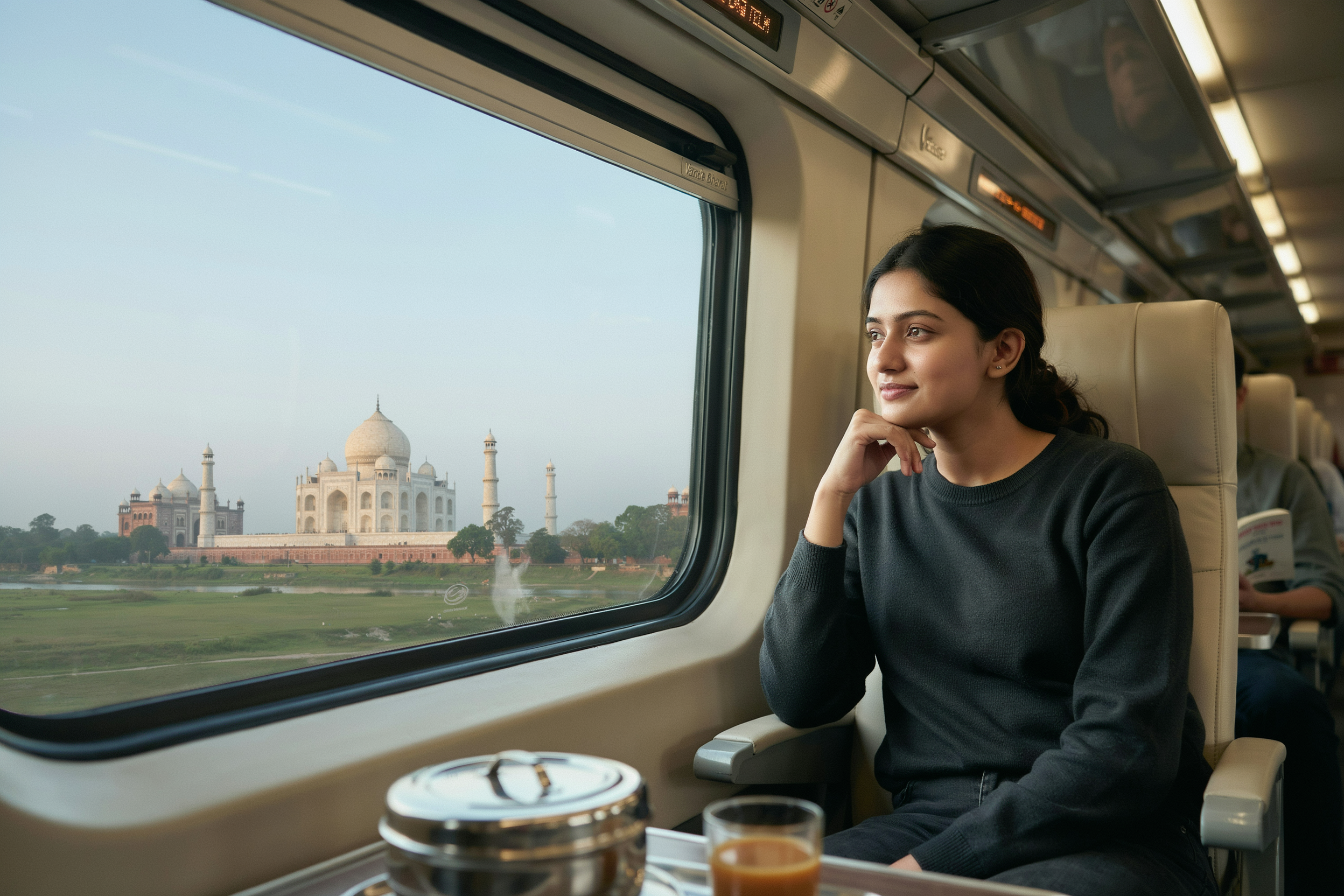
Onboard, the train feels more like a short-haul flight than a typical Indian train. The Executive Chair Car and AC Chair Car both offer wide, reclining seats, large windows, and a clean, quiet cabin. Your ticket includes a meal service. Vegetarian and non-vegetarian options are served at your seat, along with tea, coffee, and bottled water. There’s also onboard Wi-Fi on some coaches, though connectivity can be spotty. For travelers who want to rest before a long day of sightseeing, the Gatimaan Express is a far better choice than a cramped car or a crowded bus.
Another advantage is the timing. The morning Gatimaan Express departs Delhi’s Hazrat Nizamuddin station at 8:10 AM and reaches Agra Cantonment at 9:50 AM. That puts you at the Taj Mahal’s East Gate by 10:30 AM, well before the midday heat and the largest tour groups. The return train leaves Agra at 5:50 PM and arrives back in Delhi at 7:30 PM. You get a full afternoon in Agra without needing an overnight stay. This schedule works well for international travelers from the United States, the United Kingdom, Canada, Australia, France, Germany, Singapore, or Malaysia. It aligns with a typical traveler’s energy levels and lets you avoid the worst of the afternoon sun.
We also like the Gatimaan Express because it removes the biggest stress of a Delhi to Agra day trip: negotiating with drivers. When you book a private car, you have to agree on a price, confirm the pickup time, and hope the driver knows the route. With the train, you simply show up at the station, board your assigned seat, and relax. The only thing you need to arrange separately is a short transfer from Agra Cantonment to the Taj Mahal, which we cover in a later section. For most travelers, that small extra step is well worth the time saved and the comfort gained.
Gatimaan Express to Agra: Train Schedule, Classes, and Onboard Experience
The Gatimaan Express to Agra is India’s fastest train on the Delhi, Agra corridor. It covers the 188 km journey in just 100 minutes. Train 12050 departs Hazrat Nizamuddin station in Delhi at 8:10 AM and reaches Agra Cantt at 9:50 AM. That gives you a full day to explore the Taj Mahal and nearby sights. The return train, 12049, leaves Agra Cantt at 5:50 PM and arrives back at Hazrat Nizamuddin at 7:30 PM. You can enjoy a relaxed dinner in Delhi after your day trip.
We recommend booking the Executive Chair Car if you want extra legroom, wider seats, and a quieter cabin. The AC Chair Car is comfortable and more budget-friendly. It has reclining seats and plenty of overhead storage. Both classes are air-conditioned and have clean washrooms, reading lights, and charging sockets at every seat. Onboard, you’ll be served a hot meal that changes with the time of day. Breakfast on the morning run includes cutlets, bread, jam, and a choice of tea or coffee. The evening return offers a full dinner with rice, dal, paneer, and dessert. Vegetarian and non-vegetarian options are available, and the meal is included in your ticket price.
One thing we love about the Gatimaan Express is how it removes the stress of highway traffic. The Yamuna Expressway can take three to four hours by car, especially during fog or peak season. The train runs on a fixed schedule and rarely delays. You also get free Wi-Fi on board, though the signal can be patchy after Mathura. Download your Taj Mahal tickets and offline maps before you board. For a smooth start, arrive at Hazrat Nizamuddin at least 30 minutes early to clear security and find your coach. The platform is well signed, and staff are used to helping first-time visitors.
How to Book Gatimaan Express Tickets for Your Taj Mahal Day Trip
Booking Gatimaan Express tickets for your Taj Mahal day trip is straightforward once you know the two main channels: the official IRCTC website and authorized travel agents. We recommend starting with IRCTC because it gives you direct control over seat selection, class, and fare. It also avoids any middleman markup. The booking window opens 120 days in advance, which is plenty of time for most travelers. But peak season (October to March) and weekends sell out fast. We suggest locking in your seats at least two to three weeks before your planned travel date.
On the IRCTC portal, you’ll need to create an account if you don’t already have one. That requires a valid email address and an Indian mobile number for OTP verification. International travelers can use a foreign mobile number in some cases, but the process is smoother with an Indian SIM or by asking your hotel concierge to assist. Once logged in, search for trains from New Delhi (NDLS) to Agra Cantt (AGC) on your travel date. The Gatimaan Express (train number 12050) will appear near the top of the results. Select your preferred class: Executive Chair Car (EC) or Chair Car (CC). The Executive class offers wider seats, more legroom, and a quieter cabin. Chair Car is comfortable and more budget friendly.
Fares for Gatimaan Express tickets vary by class and demand. As a general guide, Chair Car typically ranges from ₹750 to ₹1,200 per person one way. Executive Chair Car runs from ₹1,500 to ₹2,200. These prices include the onboard meal service, which is a nice bonus for a day trip. You can pay by credit card, debit card, UPI, or net banking. Tickets are delivered as a PDF or accessible in the IRCTC app. If you prefer a more hands-off approach, authorized agents like those at tajtourpackages.com can book the entire package, including Taj Mahal entry and local transport. They often have the same or better seat availability because they monitor cancellations.
One practical tip for peak season: if your preferred date shows waitlisted status, don’t give up. IRCTC automatically upgrades waitlisted passengers as cancellations occur. The Gatimaan Express has a high no-show rate on weekday mornings. You can also check the Tatkal quota, which opens one day before departure at 10:00 AM IST for AC classes. Tatkal fares carry a premium of roughly 10 to 30 percent. They’re a reliable fallback when standard quota is exhausted. Whichever route you choose, book early, double-check your departure station (New Delhi, not Old Delhi), and keep a digital copy of your ticket handy for the onboard ticket check.
Planning Your Day: Delhi to Agra Train Tour Itinerary
We’ve run this Delhi to Agra train tour enough times to know that the difference between a rushed visit and a memorable one comes down to the hour-by-hour plan. The Gatimaan Express schedule is built for a full day trip, but only if you respect the buffer times. Here’s the itinerary we recommend to our travelers, with realistic timings and the small decisions that save you 30 minutes or more at the Taj Mahal.
6:00 AM: Depart from your Delhi hotel. Book a prepaid cab or use a hotel car for the 20 to 30 minute ride to Hazrat Nizamuddin station. Delhi traffic is unpredictable even at dawn, so we never schedule a pickup later than 6:00 AM. If you’re staying near Connaught Place or Karol Bagh, add 10 extra minutes. Arriving at the station by 6:30 AM gives you a calm buffer before the train departs at 8:10 AM.
6:45 AM: Enter the station and find your coach. Hazrat Nizamuddin is compact but busy. Keep your ID handy because railway staff check it against your ticket at the platform entrance. The Gatimaan Express boards about 20 minutes before departure. The platform number appears on the departure boards around 7:30 AM. We recommend grabbing a bottle of water and a light snack from the station kiosk before boarding, even though breakfast is served on the train.
8:10 AM to 9:50 AM: Enjoy the ride. The train leaves on time almost every day. Breakfast service starts within 15 minutes of departure. The Executive Class meal includes a hot option, fruit, and coffee. Use the first hour to review your Taj Mahal entry ticket on your phone and confirm your return pickup in Agra. The train arrives at Agra Cantt station at 9:50 AM. The doors open quickly, so have your bags ready.
10:00 AM: Meet your driver outside Agra Cantt. Pre-arranged cars wait near the main exit. The drive to the Taj Mahal’s East Gate takes about 15 minutes. If you’re using a local auto-rickshaw, agree on the fare before you get in. We always aim to be at the East Gate ticket counter by 10:20 AM. The queue is shortest in the late morning after the sunrise crowd has cleared.
10:30 AM to 1:00 PM: Explore the Taj Mahal. Give yourself a full two and a half hours inside the complex. That’s enough time to walk the gardens, photograph the main mausoleum from the classic reflecting pool angle, and see the mosque and guest house on either side. The museum near the west gate is worth 20 minutes if you want context before you leave. We tell our travelers to skip the inlay demonstration shops outside the gate unless they specifically want to buy marble souvenirs.
1:15 PM: Lunch in Agra. Head to a restaurant near the Taj Ganj area or back toward Sadar Bazaar. A sit-down lunch takes 45 to 60 minutes. That still leaves you time for one more stop before the train. If you want to see Agra Fort, leave the restaurant by 2:15 PM and spend 75 minutes there. If you prefer a slower pace, skip the fort and browse the marble workshops near the East Gate instead.
4:00 PM: Return to Agra Cantt station. The Gatimaan Express departs for Delhi at 5:50 PM. We recommend arriving by 4:45 PM to avoid the evening rush at the security checkpoint. The station has a dedicated waiting area for Gatimaan passengers. The platform is announced 30 minutes before departure.
5:50 PM to 7:30 PM: Ride back to Delhi. Dinner is served shortly after departure. The train reaches Hazrat Nizamuddin at 7:30 PM. From there, your pre-arranged car takes you back to your hotel in 30 to 45 minutes. This Delhi to Agra train tour works because every step has a buffer: the morning station arrival, the late-morning Taj entry, and the early return to Agra Cantt. Cut any one of those buffers and the day feels rushed. Keep them and you get a relaxed, full-value visit to the Taj Mahal without spending a night in Agra.
Arriving in Agra: Getting from the Station to the Taj Mahal
When your Gatimaan Express pulls into Agra Cantt station around 09:50, you’ll step onto the platform and immediately be greeted by a wave of touts, taxi drivers, and auto-rickshaw wallahs all competing for your attention. We recommend walking past them with a polite no and heading straight for the prepaid taxi booth inside the station. This is the most reliable way to get from the station to the Taj Mahal without haggling. It gives you a fixed, printed fare before you commit.
The drive from Agra Cantt to the Taj Mahal’s East Gate or West Gate takes about 15 to 20 minutes depending on traffic. A prepaid taxi for a small car typically costs between 300 and 400 rupees for a one-way drop. An auto-rickshaw can be negotiated for roughly 150 to 250 rupees. App-based cabs like Uber and Ola also operate in Agra. A ride usually lands in the same 250 to 400 rupee range, though surge pricing can push that higher on busy weekends and public holidays.
One thing we always tell travelers: the Taj Mahal has three gates, and your choice of gate matters. The West Gate is the most popular for independent visitors because it opens earlier and has the longest ticket queues. The East Gate is quieter and closer to many of the mid-range hotels. The South Gate is restricted to residents of Agra and isn’t an option for most tourists. If you’re taking a taxi or auto-rickshaw, ask the driver to drop you at the West Gate or East Gate, never the South Gate.
For those who prefer to skip the station chaos entirely, many travelers book a taj mahal tour by gatimaan express that includes a private car pickup from Agra Cantt. This is the smoothest option because the driver waits on the platform with a name sign, handles your luggage, and takes you directly to the gate without any negotiation. If you’re traveling independently, the prepaid booth is still our top pick for a fair price and a stress-free start to your day at the Taj Mahal.
Taj Mahal Entry: Tickets, Timings, and What to Expect at the Gate
Buying your Taj Mahal tickets before you leave Delhi saves you from the longest queue of the day. The official Archaeological Survey of India (ASI) website and the Taj Mahal mobile app both sell timed entry slots. We recommend booking the first slot of the morning. Foreign visitors pay ₹1,100 for the main mausoleum ticket, while domestic visitors pay ₹50. There’s an additional ₹200 fee if you want to enter the main mausoleum itself. Most first-time visitors choose to do that. Children under 15 enter free regardless of nationality.
You can also buy tickets at the gate, but the ticket windows open at sunrise and the line builds fast. The East Gate and West Gate are the two main entrances for tourists. The South Gate is usually reserved for local residents and opens later. If you’re coming from the Gatimaan Express station, the East Gate is the closest and most convenient option. The West Gate tends to be busier because it’s near the main parking area and the Taj Mahal’s official ticket counters.
Security screening is thorough but straightforward. You’ll walk through a metal detector and your bags will be X-rayed. Leave large bags, tripods, drones, and any food other than water at your hotel or in a locker near the gate. The list of prohibited items is strict: no pens, no notebooks larger than a small pocket diary, no headphones, and no tobacco products. We tell our travelers to carry only a phone, a small wallet, and a bottle of water. If you bring a backpack, expect to spend extra time at the locker counter.
Timing matters more than most visitors realize. The Taj Mahal opens 30 minutes before sunrise and closes 30 minutes before sunset, every day except Friday, when it’s closed for prayers. The first hour after opening is the quietest and coolest. The light is soft for photos. The last hour before closing is also less crowded, but the heat can be intense in the afternoon. We plan our Gatimaan Express day trips so you arrive at the East Gate by 10:30 a.m. That gives you about four hours inside before the afternoon rush.
What to bring: your passport or a photocopy of the photo page, your printed or mobile ticket with the QR code, and cash for the shoe covers that are required inside the mausoleum. The shoe covers cost ₹10 and are handed out just before you step onto the marble platform. Avoid wearing anything with a lot of metal. You’ll be asked to remove belts, watches, and sometimes even shoes at the scanner. A light scarf is useful for covering your head if you enter the mosque on the western side of the complex.
Inside the Taj Mahal: A Self-Guided Walking Route
After you pass through the security check and ticket gate, the first thing you see is the Great Gate. It’s a red sandstone portal with white marble inlay and calligraphy from the Quran. Walk through it slowly. The gate frames the Taj Mahal perfectly, and this is where most travelers stop for their first photo. The sight of the white marble dome rising above the gardens is one of the most memorable moments of any taj mahal tour by gatimaan express.
From the gate, follow the central water channel straight ahead. The channel splits the charbagh garden into four quadrants, a classic Mughal design that represents paradise. On both sides, cypress trees and flower beds line the walkway. Take your time here. The garden offers the best wide-angle shots of the mausoleum, especially in the early morning when the light is soft and the crowds are thinner.
At the end of the garden, you reach the marble platform. Before climbing the steps to the main mausoleum, turn left and visit the mosque. This red sandstone building with three white domes is still used for Friday prayers. It faces the Taj Mahal and gives you a side view that most tourists miss. On the opposite side is the jawab, a mirror-image building that was built for symmetry and never used as a mosque.
Now climb the steps to the main mausoleum. You’ll need to put on shoe covers or remove your shoes before entering. Inside, the light is dim, and the space is smaller than most people expect. The central chamber holds the cenotaphs of Mumtaz Mahal and Shah Jahan. The actual graves are in a crypt below, which is closed to visitors. Photography isn’t allowed inside the mausoleum. Put your camera away and take a moment to appreciate the marble screens and inlay work.
When you exit, walk around the back of the mausoleum. The view of the Yamuna River and the red sandstone wall is quiet and peaceful. This is also a good spot for photos without the crowds in the garden. Remember to keep your voice low and avoid touching the marble surfaces. The Taj Mahal is a UNESCO World Heritage Site and a place of deep cultural respect.
Where to Eat and What Else to See in Agra
After a morning at the Taj Mahal, you’ll be hungry and ready for a break. The good news is that Agra has plenty of solid lunch options within a 10-minute drive of the East Gate. For a reliable, tourist-friendly meal, head to one of the rooftop restaurants along Fatehabad Road. Most serve North Indian thalis, butter chicken, and fresh naan. The view of the Taj in the distance is a nice bonus. Expect to pay between 400 and 800 rupees per person for a full lunch. If you want something quicker and cheaper, the local dhabas near the station serve simple dal, rice, and roti for under 200 rupees. They’re a great way to taste everyday Agra food without the tourist markup.
Once you’ve eaten, you still have time to see more of Agra before your evening train back to Delhi. The most obvious add-on is Agra Fort, a massive red-sandstone complex just 2.5 kilometers from the Taj. Budget at least 90 minutes to walk the courtyards and ramparts. The fort offers one of the best photo angles of the Taj across the Yamuna River. If you prefer a quieter, open-air stop, Mehtab Bagh is a riverside garden directly opposite the Taj. Entry costs only 300 rupees for foreigners. The late-afternoon light there is superb for photography. Both sites fit comfortably into a Gatimaan Express day trip, as long as you keep lunch to under an hour.
For shoppers, the lanes around Kinari Bazaar and the Sadar Bazaar area are worth a quick walk. You’ll find marble inlay boxes, leather juttis, and petha, the city’s famous sweet made from ash gourd. Bargain politely and expect to pay about half the first asking price. If you’re short on time, skip the bazaars and spend your last hour at a cafe near the station instead. A well-paced afternoon of lunch, Agra Fort, and one market stop leaves you back at Agra Cantt station with 30 minutes to spare before the return Gatimaan Express departs.
What the Taj Mahal Train Tour from Delhi Really Costs
We budget every Taj Mahal train tour from Delhi the same way we would a week of groceries: line by line, no surprises. A solo traveler taking the Gatimaan Express in Executive Chair Car and visiting the Taj Mahal on a standard foreign-tourist ticket should plan for roughly 7,500 to 9,000 Indian rupees. That’s about $90 to $110 at current exchange rates. It covers the round-trip train fare, monument entry, a private auto-rickshaw for the day, two meals, and a bottle of water at every stop.
Here’s where the money actually goes on a typical day trip:
- Gatimaan Express tickets: 1,510 rupees each way in Chair Car, or 2,265 rupees each way in Executive Chair Car. Round trip, that’s 3,020 or 4,530 rupees.
- Taj Mahal entry: 1,300 rupees for foreign tourists, 50 rupees for Indian citizens, plus an optional 200-rupee ticket for the main mausoleum queue.
- Local transport in Agra: 800 to 1,200 rupees for a full-day auto-rickshaw covering the station, Taj Mahal, Agra Fort, and a lunch stop. Prepaid booths at Agra Cantt station keep the price honest.
- Meals and drinks: 600 to 1,000 rupees for a sit-down lunch and two or three bottles of water, depending on whether you choose a mid-range restaurant or a thali place near the East Gate.
- Incidentals: 200 to 400 rupees for shoe covers, a small tip for the rickshaw driver, and a phone-charging stop if needed.
For a couple traveling together, the per-person cost drops slightly because the auto-rickshaw and some incidentals are shared. A realistic budget for two people is 13,000 to 16,000 rupees total, or about $160 to $195. We always suggest carrying 2,000 rupees in cash per person. Card machines at the Taj Mahal ticket window and smaller Agra eateries aren’t reliable.
One cost people forget is the early-morning transfer from your Delhi hotel to Hazrat Nizamuddin station. That’s usually 300 to 600 rupees by app-based cab, depending on your neighborhood. If you’re staying near New Delhi station, you can take the metro for under 60 rupees and walk to the platform.
Compared with a private car tour, which typically starts at 12,000 rupees for two people, the Gatimaan Express route saves you 30 to 40 percent while cutting travel time nearly in half. The only real variable is how much you spend on food and souvenirs inside Agra. That’s entirely in your hands.
Common Mistakes to Avoid on a Gatimaan Express Taj Mahal Trip
We’ve watched hundreds of travelers make the same avoidable errors on a taj mahal tour by gatimaan express. Most of them come down to one thing: treating this like a casual local train ride instead of a timed, high-demand experience. The good news is that every mistake below is easy to prevent once you know what to look for.
Booking too late is the biggest one. Gatimaan Express tickets open 120 days in advance. The morning departure from Delhi to Agra sells out fast, especially from October to March and on weekends. If you wait until the week before, you’ll likely find only waitlisted seats or be forced onto a slower train that eats into your Taj Mahal time. We always recommend locking in your seats the moment your travel dates are firm. If you’re traveling in a group of three or more, book even earlier because adjacent seats disappear quickly.
Underestimating station crowds is the second mistake. Hazrat Nizamuddin station in Delhi is busy at 6 a.m. The security line can take 20 minutes on a normal day. If you arrive 15 minutes before departure, you’ll be sprinting with your bags while the platform announcement plays. Give yourself a full 45 minutes at the station. The same applies on the return: Agra Cantt station gets congested in the late afternoon. The evening Gatimaan Express back to Delhi is just as popular as the morning run.
Forgetting your ID is a guaranteed problem. Indian Railways requires a government-issued photo ID that matches the name on your ticket for every passenger, including children. A passport, driver’s license, or Aadhaar card all work. A photocopy or a phone screenshot doesn’t. Keep the original in an easy-to-reach pocket. You’ll need it at the platform gate and sometimes again on board.
Carrying prohibited items will slow you down. Large knives, scissors, lighters, and aerosol sprays aren’t allowed in your cabin luggage. Agra’s Taj Mahal security check is even stricter: no food, no tripods, no large bags, and no tobacco products. We see travelers pack a full day bag and then waste 30 minutes at the Taj cloakroom. Bring only a small crossbody bag with your wallet, phone, water bottle, and camera. Leave everything else at your hotel or in the station cloakroom.
Misjudging the return train timing is the mistake that ruins the day. The Taj Mahal deserves at least three hours. Agra Fort adds another hour. If you book the 5:50 p.m. Gatimaan Express back to Delhi, you need to leave the Taj complex by 4:15 p.m. to clear traffic and security. Many travelers book the last train thinking they’ll have more time, then spend the final hour watching the clock instead of the marble. We recommend the 5:50 p.m. departure and a hard stop at 4 p.m. at the Taj gate. That gives you a relaxed buffer and a comfortable ride back to Delhi by 7:30 p.m.
Frequently Asked Questions
How far in advance should I book Gatimaan Express tickets for a Taj Mahal tour?
We recommend booking at least 7 to 10 days ahead for weekend or holiday travel, because the train sells out quickly. For weekday trips, 3 to 4 days is usually enough. Booking early also gives you a better choice of seat class, especially Executive Chair Car, which has only 56 seats per coach.
Can I store luggage at Agra Cantt station during my Taj Mahal visit?
Yes. Agra Cantt has a staffed cloakroom where you can leave bags for a small fee, usually around 20 to 30 rupees per bag for a few hours. Keep your valuables with you and carry a lock for your bag. The cloakroom is near the main exit, so you can drop bags before heading to the Taj Mahal.
Is a one-day Taj Mahal tour by Gatimaan Express enough time to see Agra properly?
For most travelers, yes. The train leaves Delhi around 8:00 AM and reaches Agra before 10:00 AM, giving you about 7 hours in the city. That’s enough for the Taj Mahal, Agra Fort, lunch, and a quick stop at a marble workshop. You’ll be back in Delhi by 7:30 PM, tired but satisfied.
What is the best seat class on the Gatimaan Express for a day trip?
Executive Chair Car is our top pick. It costs more than Chair Car, but the seats are wider, the cabin is quieter, and the meal service is more generous. Chair Car is perfectly comfortable for a 100-minute ride. It’s a good value choice if you want to save money for a nicer lunch in Agra.
Can I buy Gatimaan Express tickets on the same day as my Taj Mahal visit?
It’s possible but risky. Same-day tickets are sold at the station counter only if seats remain, and the train is often full by morning. If you must travel last minute, arrive at Hazrat Nizamuddin station by 6:30 AM and be ready to accept any class. We strongly advise against planning a same-day ticket for a weekend or festival date.

Leave A Comment
You must be logged in to post a comment.