
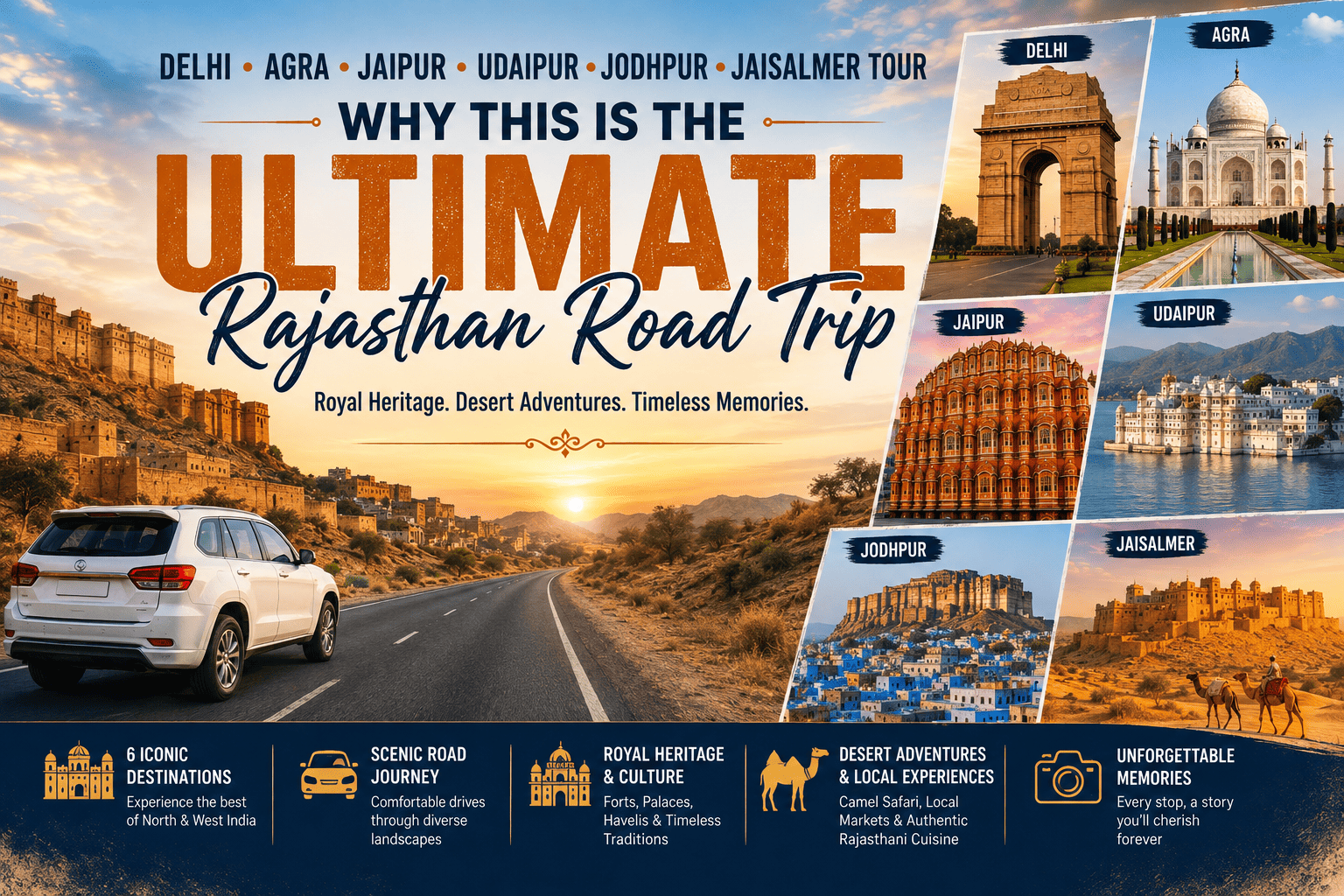
This route earns the word “ultimate” for a specific reason: it’s the only common itinerary that takes you through every major landscape Rajasthan has — imperial Delhi, Mughal Agra, royal Jaipur, lakeside Udaipur, desert-edge Jodhpur, and true-desert Jaisalmer — in one continuous 9-day loop. Shorter Rajasthan trips have to pick a theme. This one doesn’t have to choose.
Where the classic Golden Triangle is a history tour and the Jodhpur-Pushkar extension adds culture and pilgrimage, this route adds an entirely different dimension on top of both: water and desert, in the form of Udaipur’s lakes and Jaisalmer’s dunes, at opposite ends of Rajasthan’s landscape.
What “Ultimate” Actually Means on This Route
Four cities, four completely different identities:
Jaipur is Rajasthan’s royal showpiece — pink sandstone, Rajput forts, imperial scale.
Udaipur is the opposite register entirely: the City of Lakes, built around Lake Pichola and the white-marble City Palace, with a romantic, almost Mediterranean feel that’s unlike anywhere else on the route.
Jodhpur returns to fort-and-desert territory, but with its own visual signature — the Blue City’s indigo-washed old town beneath the towering Mehrangarh Fort.
Jaisalmer goes further still, into genuine Thar Desert territory. Its fort, Sonar Kila (“Golden Fort”), is one of the few living forts left in the world — meaning people still reside inside its walls — and it’s the gateway to camel safaris in the Sam sand dunes.
No other common Rajasthan itinerary strings all four of these together. That’s what separates “ultimate” from marketing language here — it’s a genuinely complete cross-section, not just a longer version of the same three cities.
The Route, City by City
Delhi → Agra → Jaipur runs at classic Golden Triangle pace — a few hours between each stop, with the sunrise Taj Mahal and a Fatehpur Sikri stop along the way, exactly as on the shorter routes.
Jaipur → Udaipur is where this itinerary diverges. After a full day of Jaipur’s forts and palaces, the drive continues south into a different Rajasthan.
Udaipur gets a full sightseeing day of its own: Lake Pichola by boat, City Palace, Jagdish Temple, Fateh Sagar Lake, and the Saheliyon ki Bari gardens.
Udaipur → Jodhpur is a roughly 5-hour drive broken up by a stop at the Ranakpur Jain Temple — a marble temple complex with 1,444 individually carved pillars, no two alike, and one of the most architecturally significant religious sites in India. It’s a genuine highlight of the drive, not just a rest stop.
Jodhpur covers Mehrangarh Fort, Umaid Bhawan Palace, Jaswant Thada, and the Blue City’s old lanes.
Jodhpur → Jaisalmer, about 4 hours, pushes further west into increasingly desert terrain.
Jaisalmer closes the loop with the fort itself, its carved-sandstone havelis (Nathmal Ki Haveli, Patwon Ki Haveli), Gadisar Lake, and a sunset camel safari in the Sam dunes.
Jaisalmer → Delhi is done by flight rather than road — the only leg of the trip not covered by car, since driving back from the far western edge of Rajasthan would add another full day for no real benefit.
How Long and How It’s Driven
At 9 days and roughly 8 nights, this is a longer commitment than either the classic Golden Triangle (5–6 days) or the Jodhpur-Pushkar extension (7 days) — which makes sense, since it covers six cities instead of three or five. Most of the trip runs by private air-conditioned car with a driver for the full route and local guides joining in each city, the same setup used on the shorter Rajasthan-by-car itineraries.
The one exception is the final leg: Jaisalmer sits far enough west that flying back to Delhi is standard practice rather than a long, low-value drive. A well-sequenced version of this trip — like this Delhi-Agra-Jaipur-Udaipur-Jodhpur-Jaisalmer tour by car — builds that flight in already, along with the Ranakpur stop and the Sam dunes camel safari, so the logistics of the longest, most geographically spread-out route on this list are handled rather than left for you to piece together. This is one of the longer routes Aiza Tours runs, with a consistent driver and vehicle across the full 9 days and the Jaisalmer-Delhi flight arranged as part of the package.
Best Food to Eat Along the Route
Udaipur adds its own note to Rajasthan’s food identity — lighter, lake-city dining alongside the standard Rajasthani thali, with several rooftop restaurants overlooking Lake Pichola worth timing for sunset.
Jodhpur’s Mirchi Bada and Makhaniya Lassi are still the standouts from the Clock Tower market area, exactly as on the shorter Jodhpur routes.
Jaisalmer brings Ker Sangri, a dry desert-bean and berry dish unique to this arid part of Rajasthan, along with Dal Baati Churma made slightly differently than Jaipur’s version. Desert-region food here leans dry and long-lasting by necessity — you’ll notice more pickled and preserved dishes than anywhere else on the route.
Best Shopping Places
Udaipur is known for miniature paintings in the Mewar style, alongside silver jewelry and traditional puppets (kathputli) sold near the City Palace.
Jodhpur’s Sardar Market and Clock Tower area remains the best stop for textiles, spices, and antiques.
Jaisalmer stands apart for its stone and mirror-work handicrafts, along with intricately embroidered textiles sold in the lanes around the fort — a distinct style from anything found in Jaipur or Jodhpur, reflecting the desert region’s specific craft traditions.
Best Activities to Cover
Udaipur: A boat ride on Lake Pichola at sunset, with views of the Taj Lake Palace floating on the water, is the city’s defining experience and unlike anything else on the route.
Jodhpur: Mehrangarh Fort, plus the Flying Fox zip-line across its ramparts for a different vantage point.
Jaisalmer: A night in a desert camp near the Sam sand dunes, with a camel ride at sunset and dinner under open sky, is the trip’s signature closing experience — genuinely different from anything in the first six days.
How This Compares to Shorter Rajasthan Routes
| Golden Triangle | + Jodhpur & Pushkar | This Route (+ Udaipur & Jaisalmer) | |
|---|---|---|---|
| Cities | 3 | 5 | 6 |
| Duration | 5–6 days | 7 days | 9 days |
| Core themes | Imperial history | + desert culture, pilgrimage | + lakes, true desert |
| Return transport | Train-friendly | By car | By car, then flight from Jaisalmer |
| Signature add | Taj Mahal sunrise | Camel safari, Brahma Temple | Lake Pichola boat ride, Sonar Kila |
| Best for | First-time, tight schedule | Deeper Rajasthan culture | The most complete Rajasthan trip possible in one loop |
Best Time to Go
October to March applies here even more strongly than on the shorter routes, since this itinerary spends real time in Jaisalmer, the hottest and driest stretch of the trip. Summer temperatures in the Thar Desert routinely climb well past what’s comfortable for sightseeing or a camel safari, so the cooler months aren’t just preferable here — they’re close to essential for the desert leg specifically.
Common Questions
Is 9 days realistic, or should this be split into two trips? It’s a long trip, but it’s designed as one continuous loop rather than two separate journeys stitched together — the drive sequence (Jaipur → Udaipur → Jodhpur → Jaisalmer) flows in one direction without backtracking.
Why does the trip end with a flight instead of driving back to Delhi? Jaisalmer sits far enough west that a return drive would add a full extra day of highway travel with no sightseeing value — flying back is the standard, more efficient close to this specific route.
Is Udaipur worth it if the rest of the trip is fort-focused? Yes — Udaipur is the one city on this route with no fort-and-desert theme at all. Its lakes and palace architecture are a genuine change of pace, not a repeat of Jaipur or Jodhpur.
How different is Jaisalmer from Jodhpur if I’ve already seen the Blue City? Considerably. Jodhpur’s fort sits above a city; Jaisalmer’s fort is a living town within its own walls, and the surrounding Thar Desert and dune camel safari have no real equivalent earlier in the trip.
Do I need any special preparation for the desert leg in Jaisalmer? Sun protection, hydration, and light layering for cool desert evenings are worth planning for, especially around the camel safari and overnight camp — daytime and nighttime temperatures in the Thar Desert can differ significantly even in the cooler travel months.

Leave A Comment
You must be logged in to post a comment.