
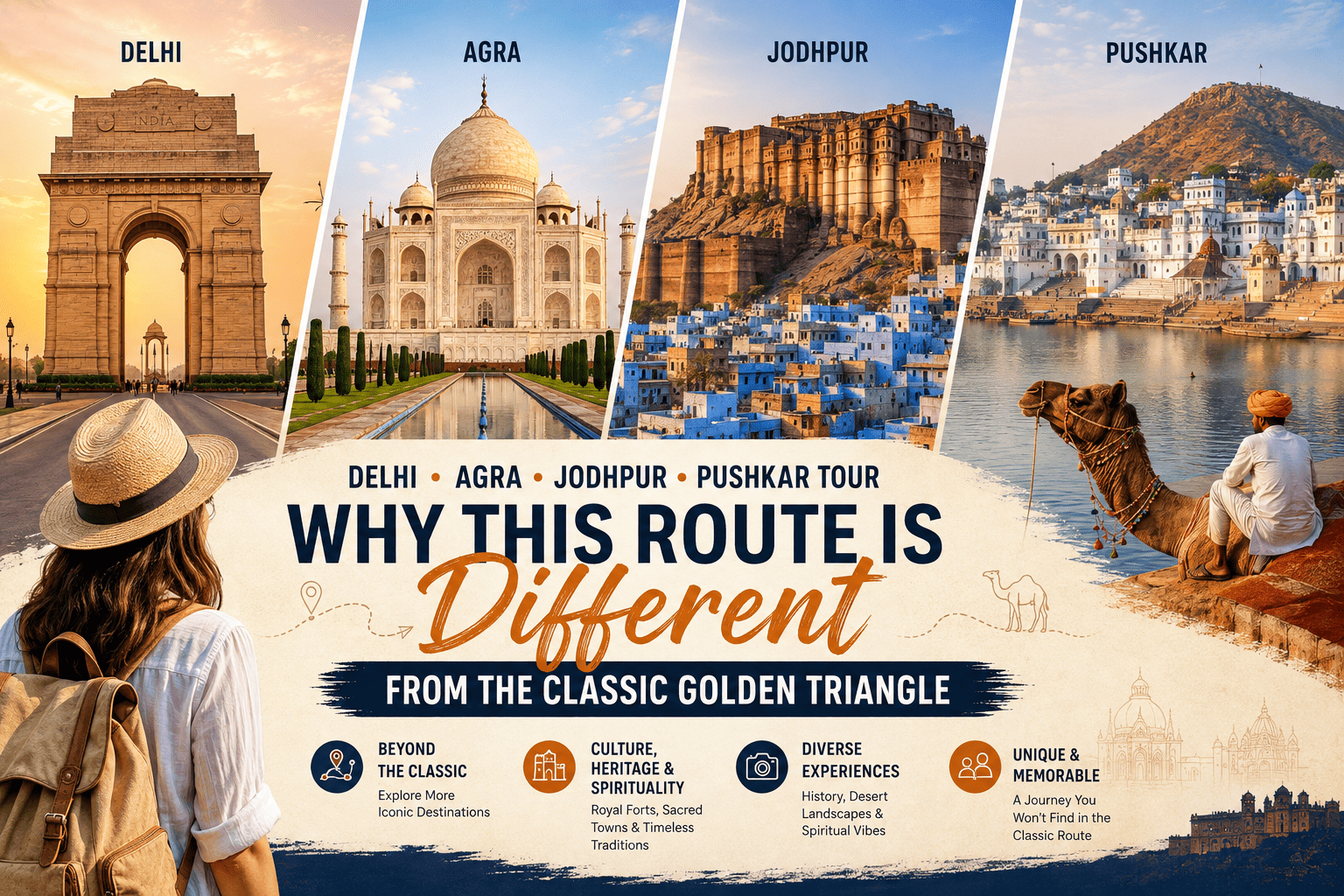
The classic Golden Triangle is Delhi, Agra, and Jaipur – three cities, one theme, roughly 5 days. The Delhi-Agra-Jodhpur-Pushkar route keeps the first two stops and then breaks away from Jaipur entirely, trading the third corner of the “triangle” for two cities deeper into Rajasthan. It’s not a longer version of the same trip. It’s a different trip that happens to share its first half.
Here’s what actually changes once Jodhpur and Pushkar replace, or extend past, Jaipur.
The Classic Golden Triangle Is a History Tour
Delhi, Agra, and Jaipur are connected by one throughline: Mughal and Rajput imperial power. Delhi’s Red Fort and Humayun’s Tomb, Agra’s Taj Mahal and Agra Fort, Jaipur’s Amber Fort and City Palace – every stop is a former seat of power, built to display wealth and authority. The “triangle” shape isn’t incidental either: these three cities sit close enough together that the route works as a tight, efficient loop, which is exactly why it became the default first-time-visitor itinerary to India.
It’s a strong trip. It’s also, by design, one kind of trip.
Jodhpur and Pushkar Are a Different Kind of Rajasthan
Jodhpur keeps the fort-and-palace theme but pushes it further into the desert, both geographically and visually. Mehrangarh Fort sits on a sheer rock face nearly 400 feet above the city – a more dramatic, less manicured version of what you saw in Jaipur. Below it, the Blue City’s indigo-washed old town looks nothing like Jaipur’s pink sandstone streets. Same royal-history theme, completely different visual language.
Pushkar breaks the theme entirely. There’s no fort, no palace, no royal history to speak of. Instead, it’s built around Pushkar Lake and the Brahma Temple – one of the only temples to the creator god in Hindu mythology anywhere in India. Where Delhi-Agra-Jaipur is a tour of what kings built, Pushkar is a tour of what pilgrims still do, unscripted, on the same ghats they’ve used for generations.
The Route Shape Changes, Not Just the Stops
The classic Golden Triangle is a genuine triangle – Delhi, Agra, and Jaipur sit close enough to loop back to Delhi in around 5 days without much drive fatigue. Add Jodhpur and Pushkar and the shape stretches into more of a long line heading southwest into Rajasthan, then doubling back:
Delhi → Agra → Jaipur → Jodhpur → Pushkar → Delhi
That reshapes the trip’s pacing. The Delhi-Agra-Jaipur leg still moves at classic Golden Triangle speed – a few hours between each city. The Jaipur-to-Jodhpur leg is a genuine long-haul day, around 6 hours, and Pushkar-to-Delhi on the way back is similar. You’re not adding two quick side trips onto the existing loop; you’re extending the loop into a longer, slower shape that spends more time in transit and more time away from the well-trodden circuit.
Crowds and Pace Are Genuinely Different
Jaipur is the most-visited stop on the classic Golden Triangle, and it shows – Amber Fort and Hawa Mahal see heavy tourist volume, especially in peak season. Jodhpur and Pushkar see a fraction of that traffic. The forts feel less rushed, the markets feel less geared toward tour groups, and Pushkar in particular has a slower, more low-key atmosphere than anywhere on the standard 3-city route.
That’s a trade-off, not a pure upgrade. Less crowded also means less tourist infrastructure – fewer big hotel chains, more variability in restaurant quality, and a general sense of being further from the setup that makes the classic Triangle so easy for first-time visitors.
Duration and Transport Shift Too
The classic Golden Triangle runs comfortably on trains between all three cities – Delhi-Agra and Agra-Jaipur both have fast, frequent rail options. Add Jodhpur and Pushkar and that stops being true: there’s no practical train connection from Jaipur to Jodhpur on a schedule that fits a multi-city trip, and Pushkar has no meaningful tourist rail access at all. That’s why the extended route is almost always run by private car rather than by train, which also changes the trip length from a tight 5 days to a full 7.
A pre-built version of this itinerary – like this Delhi-Agra-Jodhpur-Pushkar tour package by car – sequences the whole 7 days with the long Jaipur-Jodhpur and Pushkar-Delhi drives already timed around sightseeing days, which matters more on this route than the classic Triangle, since getting those long legs wrong costs you far more than a delayed train would.
Classic Golden Triangle vs. This Extended Route
| Delhi–Agra–Jaipur | Delhi–Agra–Jaipur–Jodhpur–Pushkar | |
|---|---|---|
| Theme | Mughal and Rajput imperial history | History + desert culture + living pilgrimage |
| Route shape | Tight triangle | Extended line, deeper into Rajasthan |
| Typical duration | 5–6 days | 7 days |
| Transport | Train-friendly | Best done by private car |
| Crowd levels | Heaviest tourist traffic in India | Noticeably quieter past Jaipur |
| Signature add | Amber Fort elephant ride | Mehrangarh Fort views + Brahma Temple + camel safari |
| Best for | First-time visitors, tight schedules | Travelers who’ve done “the big three” or want more depth |
Who Should Choose Which Route
If your time is limited to 5–6 days, or this is your first trip to India and you want the highest-certainty, most infrastructure-friendly version of the trip, the classic 3-city Golden Triangle still delivers exactly what it promises. If you have the extra two days and want Rajasthan to feel like more than one repeated formula – imperial history in three different registers, plus a genuinely different spiritual experience in Pushkar – the extended route is where that comes from.
Best Food to Eat Along the Route
Food changes as noticeably as the architecture on this trip, and it’s worth planning around rather than defaulting to hotel restaurants every night.
Delhi: Start in Old Delhi – parathas at Paranthe Wali Gali, chaat and jalebi in Chandni Chowk, and butter chicken at one of the original Kundan-style restaurants near Daryaganj if you want the dish’s actual birthplace rather than a hotel version of it.
Agra: The city’s signature is petha, a translucent sweet made from ash gourd – Panchhi Petha is the best-known shop. For a real meal, Mughlai-style kebabs and biryani reflect Agra’s Mughal-era food traditions directly.
Jaipur: Dal Baati Churma – lentils, baked wheat dumplings, and a sweet crumble – is the Rajasthani staple to try here, alongside Laal Maas (a fiery mutton curry) for non-vegetarians and Ghewar, a disc-shaped sweet especially common around festival season.
Jodhpur: Mirchi Bada (a stuffed, battered chili fritter) and Makhaniya Lassi (a thick, saffron-topped yogurt drink) are both street-food staples best had fresh from a stall near the Clock Tower, not a restaurant plate. Mawa Kachori, a sweet stuffed pastry, is another local specialty worth seeking out.
Pushkar: The town is entirely vegetarian, and alcohol and eggs are banned within its limits due to its religious significance – a meaningful shift after the meat-forward food of Jodhpur. Malpua (a sweet pancake) is the local specialty, and the town’s small German bakeries and rooftop cafés overlooking the lake are worth a slow breakfast rather than a rushed one.
Best Shopping Along the Route
Each city has a genuinely different specialty, which makes shopping on this route less repetitive than it might sound.
Delhi: Chandni Chowk for spices, textiles, and traditional silver jewelry; Janpath Market for more tourist-friendly clothing and handicrafts at negotiable prices.
Jaipur: Johari Bazaar for gemstones and jewelry – Jaipur is one of India’s major centers for precious and semi-precious stones – and Bapu Bazaar for textiles, block-printed fabric, and traditional jootis (leather shoes). Blue pottery, unique to Jaipur, is also worth seeking out specifically here rather than assuming it’s available everywhere in Rajasthan.
Jodhpur: The Clock Tower and Sardar Market area is the center of it – antiques, spices, textiles, and the region’s distinctive silver and lac (resin) jewelry. Jodhpur is also known for handcrafted wooden furniture, though that’s a harder souvenir to bring home.
Pushkar: Smaller-scale and more bohemian than Jaipur or Jodhpur’s markets – silver jewelry, tie-dye textiles, and semi-precious stone bracelets sold along the lanes leading to the ghats. Prices here tend to be lower than in Jaipur, and bargaining is standard practice everywhere on this route.
Best Activities to Cover
Delhi: A cycle-rickshaw ride through the narrow lanes of Old Delhi, past Jama Masjid and into Chandni Chowk, is the most immersive way to experience the old city rather than viewing it from a car window.
Agra: The sunrise visit to the Taj Mahal is non-negotiable – it’s both the least crowded time and the best light for photos. Pair it with an evening stop at Mehtab Bagh across the river for the reverse view at sunset.
Jaipur: The elephant ride up to Amber Fort’s entrance is the classic activity, though some travelers now opt for a jeep instead on animal-welfare grounds – both options are typically available. Jantar Mantar, the 18th-century astronomical observatory, is also worth the hour it takes to properly understand what you’re looking at with a guide.
Jodhpur: Beyond touring Mehrangarh Fort itself, the Flying Fox zip-line course runs directly across the fort’s ramparts and moat – a genuinely different way to see the structure than walking through it. An evening walk through the Blue City’s old lanes, ideally with a local guide, is the other standout.
Pushkar: The sunset camel safari into the dunes is the most-booked activity in town, but don’t skip the evening aarti at the lake’s ghats – it’s free, unstaged, and arguably the more memorable of the two. If your dates align with the Pushkar Camel Fair in October or November, that alone can reshape the whole itinerary around it.
Common Questions
Is the Delhi-Agra-Jodhpur-Pushkar route harder to do than the classic Golden Triangle? It’s not harder, but it does involve more time in transit – the Jaipur-Jodhpur and Pushkar-Delhi legs are full driving days, unlike the shorter train hops on the classic route.
Can I do Jodhpur and Pushkar without Jaipur, or do they replace it? Most itineraries keep Jaipur and add Jodhpur and Pushkar afterward, since Jaipur is directly on the route between Agra and Jodhpur – skipping it wouldn’t actually save meaningful time.
Why is this route usually done by car instead of train? Jaipur to Jodhpur has no practical train connection on a multi-city trip schedule, and Pushkar has no meaningful tourist rail access at all, so a private car covers the whole loop without transport gaps.
Is Jodhpur worth it if I’ve already seen Jaipur’s forts? Yes – Mehrangarh Fort is on a larger scale than Amber Fort, and the Blue City’s old town looks nothing like Jaipur’s pink sandstone streets, so it doesn’t feel repetitive.
How much longer is this route than the classic Golden Triangle? Typically 2 extra days – 7 days total versus the standard 5–6 for Delhi-Agra-Jaipur alone.

Leave A Comment
You must be logged in to post a comment.