
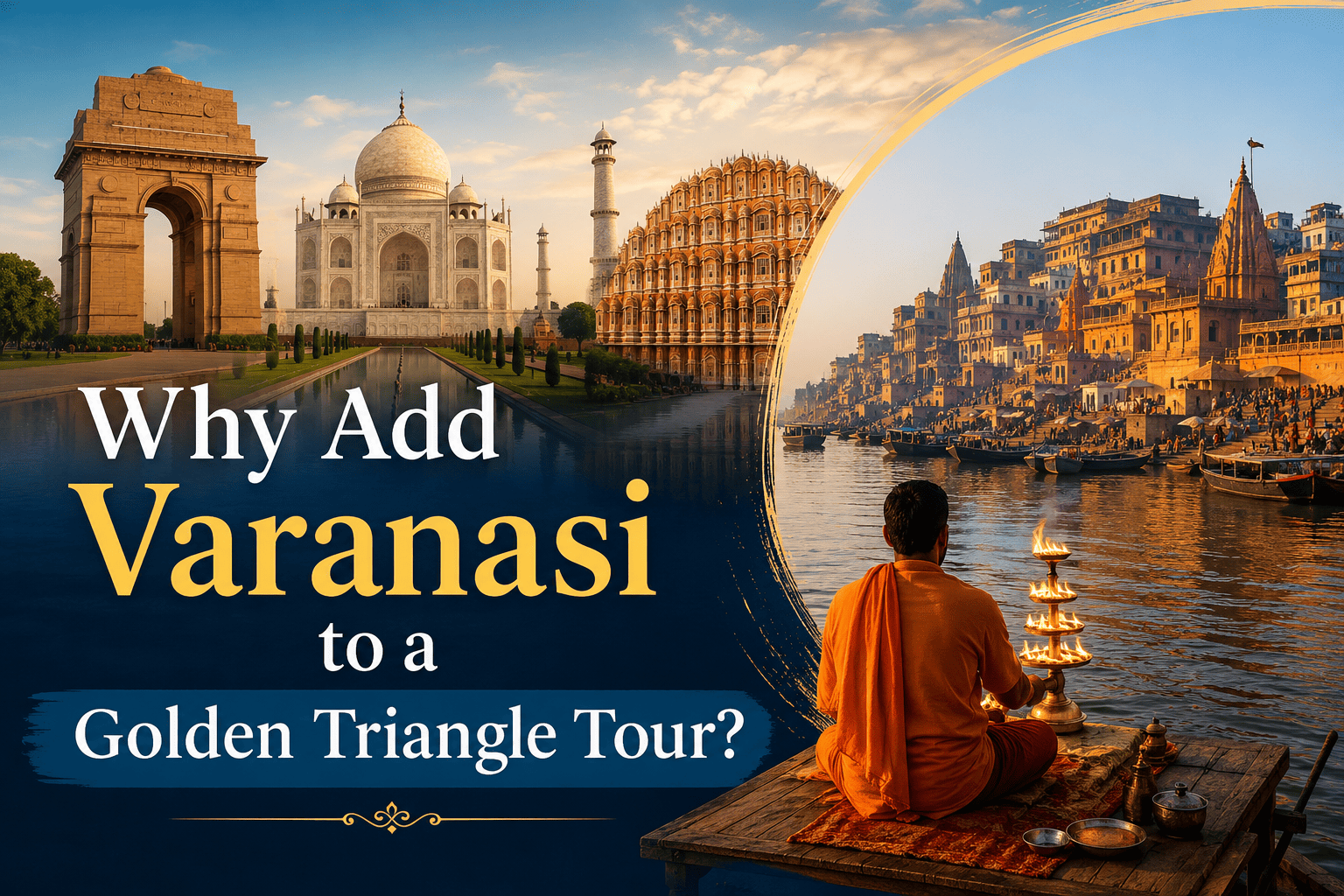
Varanasi adds what the Golden Triangle can’t offer on its own: a living, unfiltered encounter with India’s spiritual core. Delhi, Agra, and Jaipur show you the country’s imperial past – Mughal forts, marble monuments, pink-sandstone palaces. Varanasi shows you why that past exists at all: a 3,000-year-old city built entirely around the Ganges, where cremation rites, morning prayers, and daily bathing rituals happen in public, on the same stone steps they have for centuries.
Most travelers who do only Delhi-Agra-Jaipur come home with excellent photos of buildings. Travelers who extend the loop to Varanasi come home with something harder to photograph and easier to remember.
The Golden Triangle Alone Tells Half the Story
The classic circuit is built on dynastic history. Delhi’s Red Fort and Qutub Minar, Agra’s Taj Mahal and Agra Fort, Jaipur’s Amber Fort and City Palace – all of it traces Mughal and Rajput power. It’s a tour of rulers.
Varanasi, by contrast, is a tour of belief. It’s one of the oldest continuously inhabited cities on earth and the holiest city in Hinduism, predating the Mughal dynasty by well over two millennia. Adding it doesn’t extend the Golden Triangle geographically so much as it completes it thematically – you go from seeing what kings built to seeing what has outlasted every king.
What You Actually Experience in Varanasi
Sunrise boat ride on the Ganges. A rowboat past the ghats at dawn, watching pilgrims bathe, priests chant, and the city wake up along the riverbank, is the single most-cited highlight of any Golden Triangle-plus-Varanasi itinerary. It’s quiet, unstaged, and nothing like the monuments earlier in the trip.
Ganga Aarti at Dashashwamedh Ghat. Every evening, priests perform a fire ritual with synchronized lamps, bells, and chanting on the riverbank, watched by thousands. It’s one of India’s most photographed rituals for a reason – it doesn’t feel like a show put on for visitors, because it isn’t one.
Kashi Vishwanath Temple. One of the twelve Jyotirlinga shrines dedicated to Lord Shiva, and among the most important pilgrimage sites in the country. Non-Hindus can typically visit the outer complex.
The ghats themselves. Over 80 stone embankments line the river, each with its own function – bathing, cremation, laundry, yoga, meditation. Walking them on foot, rather than only viewing from a boat, is where Varanasi stops looking like a postcard and starts feeling like a place people actually live.
Sarnath. A short trip from the city center, this is where the Buddha delivered his first sermon after attaining enlightenment. For travelers interested in Buddhist history, it’s a natural half-day add-on.
The old city’s narrow lanes. Bengali Tola and the alleys around the temple district are dense with small shrines, sweet shops, silk weavers, and centuries-old houses. It’s the part of Varanasi that rewards slow, unplanned walking.
How Varanasi Fits Logistically
This is the practical reason so many operators now sell it as an extension rather than a separate trip: Varanasi connects easily to Agra by both train and flight, so it slots onto the end of a Delhi-Agra-Jaipur route without doubling back or adding a redundant leg. Most itineraries route it as Delhi → Agra → Jaipur → Delhi → Varanasi, or Delhi → Agra → Varanasi → Jaipur, depending on flight timings.
A well-built Delhi-Agra-Jaipur-Varanasi itinerary – like the one laid out in this Golden Triangle with Varanasi tour package – is usually the cleanest way to sequence it, since the transfers, permits, and boat/Aarti timings are already worked into the schedule rather than left for you to coordinate on the ground.
Golden Triangle vs. Golden Triangle + Varanasi
| Delhi–Agra–Jaipur only | Delhi–Agra–Jaipur–Varanasi | |
|---|---|---|
| Core theme | Mughal and Rajput history | History + living spiritual tradition |
| Signature experience | Taj Mahal at sunrise | Ganges boat ride at sunrise |
| Pace | Monument-to-monument | Monuments, then unstructured ghat time |
| Typical trip length | 5–6 days | 7–9 days |
| Best for | First-time visitors on a tight schedule | Travelers wanting cultural depth, not just landmarks |
Best Time to Add Varanasi
October to March is the most comfortable window – mornings are cool enough for the sunrise boat ride to be genuinely pleasant rather than a sweat-through-your-shirt endeavor. This also happens to be peak season for Delhi, Agra, and Jaipur, so it aligns naturally with the rest of the Golden Triangle circuit. If your trip includes Dev Deepawali (the “Diwali of the Gods,” usually in November), the ghats are lit with thousands of lamps – worth timing an itinerary around if your dates are flexible.
Is It Worth the Extra Days?
For travelers who’ve already done a lot of “look at this building” trips elsewhere, yes – Varanasi is the part of the itinerary people tend to talk about years later. For travelers on a strict 5-day window who specifically want the three big-ticket sights and nothing more, the classic Golden Triangle alone still delivers on that promise.
But if the goal is to understand India rather than just see three of its most famous monuments, Varanasi isn’t an optional add-on. It’s the piece that gives the rest of the trip its context.
Common Questions:
Is Varanasi safe for tourists? Yes, with the usual precautions – stick to well-traveled ghats after dark, use a guide for the old city’s lanes if it’s your first visit, and be respectful around cremation ghats (photography is generally discouraged there).
Do I need extra days, or can it be a day trip from Agra? It’s not a realistic day trip. Most itineraries budget 1.5–2 full days in Varanasi to include the sunrise boat ride, the evening Aarti, and at least a half-day for Sarnath.
Is Varanasi appropriate for non-Hindu travelers? Yes. The ghats, boat rides, and Aarti ceremony are open to all visitors, and most temples (with the exception of the innermost sanctum of a few shrines) welcome non-Hindu guests.
How do I get from Agra to Varanasi? By flight (roughly 1.5 hours, usually via Delhi) or by train (several direct overnight and daytime options). Flights are faster; trains are part of the experience for travelers who want it.

Leave A Comment
You must be logged in to post a comment.